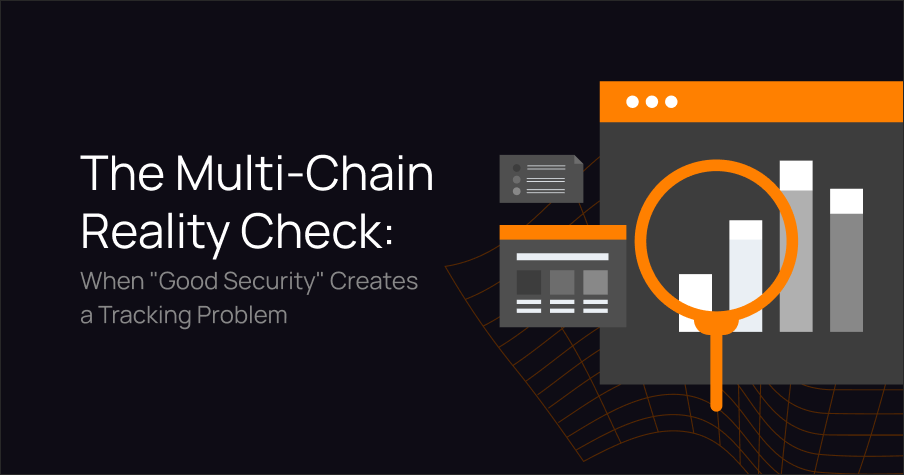
The Multi-Chain Reality Check: When "Good Security" Creates a Tracking Problem
The Multi-Chain Reality Check: When "Good Security" Creates a Tracking Problem
Hold digital assets long enough and the setup stops looking like "a wallet." It turns into a small map.
There's the long-term address that rarely moves. The "active" address used for dApps. The address that only touches one chain. The one that exists purely because someone said, "Don't keep everything in one place."
All of that is sensible. It's also how tracking becomes the real daily headache.
The Moment Things Breaks Down
Someone asks a simple question before a call. "Can we get a snapshot of our exposure across chains?" or "Which address interacted with that protocol last month?" or "Are we up overall, or just up on one chain?"
Five minutes later, the team is deep in explorers, screenshots, wallet apps, and a spreadsheet that might be outdated. Nobody feels confident. Not because the assets are at risk, but because the information is everywhere.
Good security habits create a tracking problem. When tracking breaks, control becomes guesswork.
Wallet Sprawl Isn't Sloppy— It's Defensive
In Web3, distribution is normal.
Investors split holdings across addresses to reduce blast radius. Teams separate treasury assets from experimental activity. Funds isolate higher-risk protocol interactions from core capital. Even individual investors do it after getting burned once.
This behavior is rational. Recommended, even. It's also why a "portfolio" no longer lives in one place.
Now add the parts that make modern portfolios complex: multiple chains with different standards and tooling. Stablecoins moving across networks. Governance tokens, LP positions, vesting wallets, protocol rewards. dApp interactions that matter months later, when you need context.
A single transaction can be easy to understand at the moment. Months later? Forensic exercise.
"What was this contract?" "Why did we approve that allowance?" "Was this wallet meant to be cold, or was it the active one?"
The security plan still makes sense. The tracking plan is what's missing.
The Hidden Cost is Confidence
Teams rarely fail because they can't execute transactions. They fail because they can't explain what happened, quickly and reliably.
Tracking pain shows up in unglamorous ways. A finance lead needs a monthly holdings update. A partner wants performance attribution by chain. A founder needs to confirm what moved after a market event. A trader wants to know if gains came from a strategy, or airdrop noise.
When tracking is fragmented, every answer becomes slow. Dependent on one person who "knows where things are." That's a fragile operating model.
It also creates a subtle risk—not the dramatic kind, the quiet kind. You stop noticing small drifts. You miss patterns across addresses. You forget which wallet is "safe" and which one is "dirty." You approve things twice because nobody is sure the first approval happened.
Even for a single investor, this adds friction. For a team, it becomes a governance issue.
Control is More Than Custody
Web3 discussions focus on custody. Keys. Seed phrases. Hardware. MPC. Cold storage.
Those are important. They're also only one side of control.
Control also means visibility. A team can have perfect custody and still have poor operational control if they can't answer: what is owned across all addresses, where it sits across chains, what changed over time, what actions happened and why.
In traditional finance, tracking is a given. Positions are reconciled. Exposure is measured. Reports are repeatable.
Web3 raises the bar because portfolios are distributed by design. Tracking becomes the layer that keeps distribution manageable.
This is where many tools stumble. They either try to become "everything," or they become so complex that teams avoid using them daily.
The practical need is simpler: a reliable source of truth that respects distributed security habits.
What a Tracking Layer Should Do
A tracking layer isn't another wallet. It's not a replacement for custody. It's the system that sits above wallets and chains and makes the full picture usable.
To be credible, that layer needs a few properties:
It shouldn't require unsafe behavior just to work. If tracking demands importing private keys, or copying sensitive material around, it introduces risk for the sake of convenience.
It should match how people actually operate. Multi-chain. Multiple addresses. History, not just current balances.
It should reduce cognitive load. If the dashboard creates more questions than answers, it fails the job.
It should support reporting. Not as a nice-to-have—as a basic requirement for anyone managing capital responsibly.
If those principles sound boring, that's a good sign. Boring is what makes systems reliable.
Where QoreDAM Fits
QoreDAM is built around a straightforward idea: distributed assets still need a single truth.
It's designed to consolidate portfolio visibility across multiple wallets and multiple blockchains, without forcing users to centralize custody or take on unnecessary key risk.
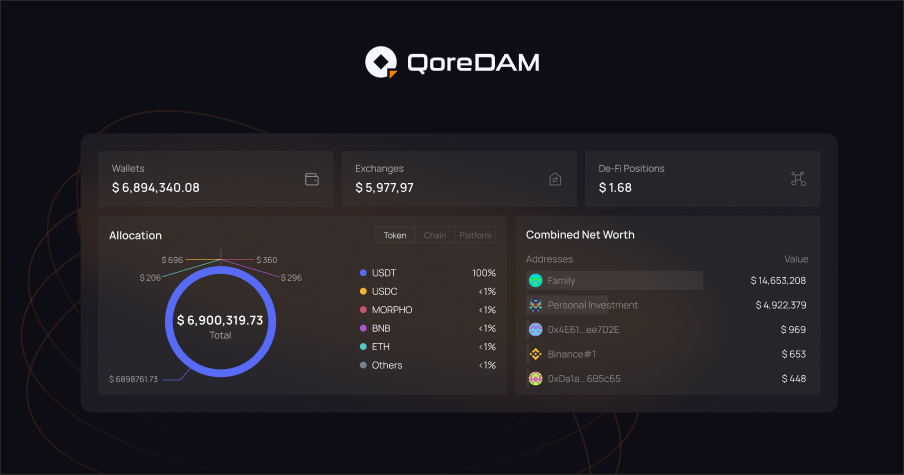
In practical terms, a user can add multiple addresses across chains and see a unified view of activity and performance. The system references publicly available blockchain data, so tracking doesn't depend on remembering every interaction, every approval, or every wallet decision made months ago.
This isn't about replacing security practices like splitting wallets. It's about supporting them. If you diversify addresses to reduce exploit exposure, you still need a clean way to track the whole set. If you interact with multiple protocols across chains, you need a way to rebuild context without spending your day on explorers.
QoreDAM is built to be that source of truth.
What QoreDAM Focuses On (and what it avoids)
Many portfolio tools compete on feature count. That can be useful for power users. It can also bury the core job.
QoreDAM stays anchored to five outcomes that map to real workflows:
Secure tracking, without importing keys. Tracking shouldn't force you to handle sensitive key material in new places. QoreDAM is designed to avoid that. The aim is visibility without expanding your attack surface.
Support for diversification habits. Security-conscious investors and teams split assets for a reason. QoreDAM is built to work with that reality, not fight it.
A single view across addresses and chains. When multiple wallets exist, the question isn't "what's in this wallet"—it's "what's the full exposure." QoreDAM is designed to make that view fast to access and easy to interpret.
Simple dashboards that stay readable. A good dashboard should reduce mental load. Simple numbers, clear movement, a view you can explain in a meeting without apologizing for complexity.
Reporting that can be reused. Tracking is only useful if it turns into repeatable reporting. QoreDAM is designed to support portfolio reports, so updates don't depend on manual stitching.
None of these claims are magical. They're testable. If a tool makes your snapshot faster and more reliable, it's working. If it makes your day more complicated, it's not.
Short Scenarios That Explain Why This Matters
The VC with too many rounds to track manually
VCs and angels have the same problem, just at different scales. Multiple investments, multiple ecosystems, multiple wallets created at different times, sometimes by different people.
At first, it feels manageable. The rounds are spaced out. The activity is light.
Then it compounds. A token unlock happens. An ecosystem migrates. A chain becomes relevant. Someone asks for a clean view of exposure across wallets. The answer is scattered.
A tracking layer turns that into a repeatable workflow. Add the addresses. Get the picture. Generate an update without rebuilding history every month.
The family office that wants oversight without chaos
Family offices care about clarity and consistency. They don't want a system that only one person understands.
They want a picture that can be checked. Reports that survive handoffs. A view that doesn't depend on memory.
Multi-chain portfolios can still be run with discipline, but only if tracking is unified and routine.
The Web2 team adding stablecoin settlement
Web2 companies moving into Web3 start with stablecoins. Practical entry point. The first month can look simple.
Then it grows. Different networks get used. Addresses multiply. Someone asks, "Are we reconciling this cleanly?" Another person asks, "Which address is for settlement, and which one is for ops?"
This is where tracking becomes operational infrastructure, not a personal tool.
QoreDAM is designed for the part after the first transaction, when reality becomes distributed.
The Broader Trade-Off: Visibility VS. Single Points of Failure
Teams want one view. They don't want one point of failure.
A bad approach tries to solve visibility by pulling everything into one place—risky key handling included. A good approach respects distribution and gives visibility without changing custody posture.
That's the debate QoreDAM sits inside. It aims to make tracking unified while keeping security habits intact. It's not a promise that risk disappears. It's a commitment to a safer, clearer operating model.
A Quick Note on Scalability
Tracking problems scale faster than people expect.
The number of addresses grows. Chain coverage expands. History gets longer. Reporting becomes more frequent. Suddenly, the cost isn't just money but attention.
QoreDAM is built with a microservice architecture to support growth without turning tracking into a fragile, monolithic system. It's designed to retrieve long historical data through blockchain RPC calls with low latency, because "what happened before" is as important as "what's happening now."
This matters for any serious operator. History is where context lives. Without it, teams make decisions with partial information.
**A Practical Checklist **
A tracking system is doing its job if:
- You can explain total exposure across chains in minutes, not hours
- You can answer what changed since last week without manual detective work
- You can hand off the process to another person without losing reliability
- You can produce a report that's consistent enough to repeat monthly
If the current workflow depends on a spreadsheet that must be "kept alive," that's a signal. If a single team member is the only source of truth, that's another one.
Those are operational risks, even if custody is strong.
Where QoreWallet Fits (Custody With Team Controls)
QoreDAM answers the tracking question: what do we own, where does it live, and what's changed? QoreWallet handles a different problem—how teams actually custody and transfer assets without the whole operation riding on one person's memory.
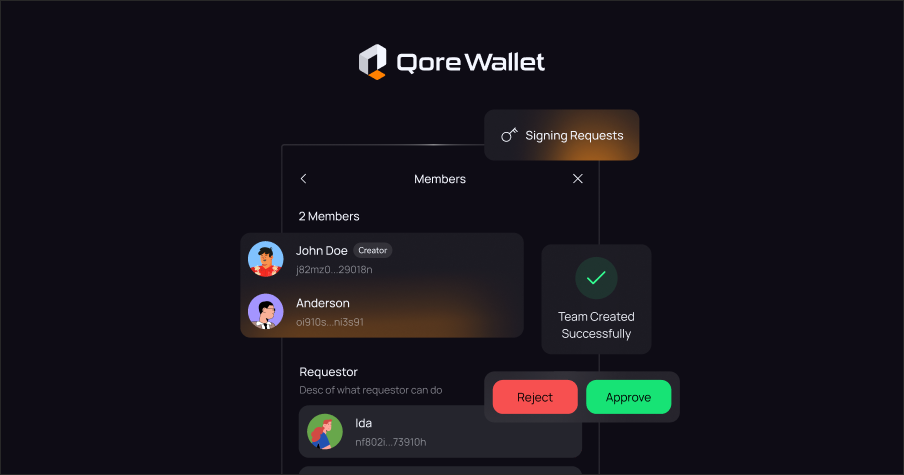
Real-world setups don't run on a single wallet. There are roles. Approvals. Separation of duties. Someone queues the transaction, someone else reviews it, a third party signs when everything checks out against policy. That's the divide between how individuals manage crypto and how organizations need to operate. QoreWallet builds for that team environment—structured around shared control and transparent accountability so you're not stuck waiting on whoever happens to be online or scrambling to figure out who has the keys.
Closing: Control Shouldn't Be a Memory Test
Web3 portfolios are distributed for good reasons. That distribution is part of modern security.
But distribution without unified tracking turns control into a daily guessing game. It drains time, increases error rates, and makes teams less confident than they should be.
A tracking layer brings discipline back to the surface.
QoreDAM is built for that reality. It's designed to give digital asset natives a clear, unified view across wallets and chains, with security and simplicity as constraints, not afterthoughts.
Because true freedom of control requires proper tracking.
If the current portfolio picture lives across explorers, apps, and old spreadsheets, it may be time to make the picture easier to run.