Track Multiple Crypto Wallets: Stop Losing Track of Your Bags
Track Multiple Crypto Wallets: Stop Losing Track of Your Bags
You funded twelve deals last year. Eight of those portfolios involve multiple wallets. Half of those wallets span at least three chains. And somewhere in that mess is a token that just vested, a liquidity position that's quietly bleeding, and a wallet your analyst set up during a hackathon that nobody's looked at since.
This is not a hypothetical. This is Tuesday morning for most Web3 VCs.
The ability to track multiple crypto wallets sounds like a basic hygiene problem. And in theory, it is. But the tools most people reach for were not built for your situation. Block explorers are fine for checking a single transaction. Spreadsheets work until they don't. And every portfolio tracker that promises a "unified dashboard" seems to fall apart the moment you throw eight chains and forty wallets at it.
This article is for investors managing real portfolio complexity. It covers what proper multi-chain wallet tracking looks like, where most tools fail, and why the answer is simpler than the industry wants you to think.
The Wallet Sprawl Problem Nobody Warned You About
When you make your first few Web3 investments, wallet management feels manageable. One fund wallet. One or two portfolio companies. A handful of chains.
Then the portfolio grows.
Suddenly you are tracking founder allocations, treasury wallets, vesting contracts, liquidity pool positions, and staking addresses across Ethereum, Arbitrum, Solana, Base, and three chains you agreed to support because the deal was too good to pass on. Each of those addresses is its own data silo. None of them talk to each other natively. And none of them know that you, the investor, exist.
This is wallet sprawl. It happens quietly and compounds fast. And it is worth saying clearly: the sprawl is not the result of poor discipline. Splitting assets across multiple addresses to reduce blast radius is rational behavior. It is what security-conscious teams are supposed to do. The problem is that no one tells you how to track the result.
The real issue is not the number of wallets. It is the cognitive overhead of monitoring them. Every time you want a clear picture of where your portfolio actually stands, you are either running a multi-tab browser session or asking your analyst to compile a report that is already out of date by the time it lands in your inbox.
Portfolio companies lose tokens to forgotten wallets. Vesting schedules slip past unmonitored. Liquidity positions get left open long after the strategic rationale has expired. None of this happens because investors are careless. It happens because the tooling never caught up with how complex Web3 portfolios actually get.
Why Spreadsheets and Block Explorers Don't Scale
Block explorers are the first tool most people reach for when they want to check a wallet. Etherscan, Solscan, the relevant chain explorer. Paste the address, done. And for a single transaction or a one-off lookup, they work fine.
The problem is that block explorers are lookup tools, not monitoring tools. They show you what happened, not what is happening. They have no concept of a portfolio. They do not aggregate across wallets. They do not flag anomalies. You cannot build a vesting schedule view in Etherscan.
So people turn to spreadsheets. And spreadsheets are genuinely useful for a while. You can build your own schema, track cost basis, note down what belongs to whom. A good analyst can maintain a reasonably accurate picture of a portfolio across a dozen wallets if they are disciplined about it.
But "disciplined about it" is the catch.
Spreadsheets require manual updates. Every price change, every transaction, every new wallet address added to a round has to be entered by a human. The moment your portfolio hits a certain size, that human is spending more time maintaining the spreadsheet than analyzing what is in it. And the moment that human leaves your team or goes on holiday, the spreadsheet starts rotting.
Beyond the maintenance burden, there is the accuracy problem. Spreadsheets cannot verify on-chain state. They record what someone believed to be true at the time of entry. If a founder moves tokens to a new wallet, your spreadsheet does not know. If a vesting contract gets modified, your spreadsheet does not know. If a liquidity pool goes sideways, your spreadsheet really does not know.
For a portfolio of two or three wallets, this is manageable. For anything larger, you are flying partially blind.
The Security Paradox: Better Safety, Worse Visibility
Here is a tension that does not get discussed enough in the context of portfolio tracking.
As portfolios mature and the amounts involved get larger, security practices get tighter. Multi-sig wallets become standard. Hardware wallets replace hot wallets. Addresses get rotated. Treasury management becomes more sophisticated and more compartmentalized. For teams specifically, this often means layering in MPC wallet infrastructure with role-based approvals and separation of duties between the people who initiate transactions, the people who review them, and the people who sign off.
All of this is correct. All of this makes the portfolio safer.
It also makes the portfolio harder to see.
When assets are spread across multiple cold wallets, several multi-sig setups, and a mix of custodial and non-custodial addresses for different fund entities, the natural visibility you had in the early days disappears. You now need to be able to see across all of those structures without undermining the security that protects them.
The stakes here are not abstract. In 2024 alone, compromised private keys accounted for nearly 44% of all stolen crypto value, with an estimated $2.2 billion lost across hacking incidents industry-wide (Coincover, 2025). Most tracking tools make this worse because they ask for something they should never need. Seed phrases. Private keys. Wallet connections. The moment a tracking tool asks you to connect a wallet or import credentials, it has introduced a security surface that should not exist. You are now trusting that tool with access to something it has no business touching.
Read-only tracking is not just a nice-to-have. It is the only rational way to monitor wallets at scale without creating new attack vectors. You should be able to observe any wallet you have a legitimate reason to watch using only its public address, without signing anything, without connecting anything, and without giving any tool the ability to initiate a transaction.
This sounds obvious. It is surprisingly hard to find in practice.
What Proper Tracking Looks Like in Web3
There is a version of multi-wallet tracking that actually works. It has a few consistent characteristics.
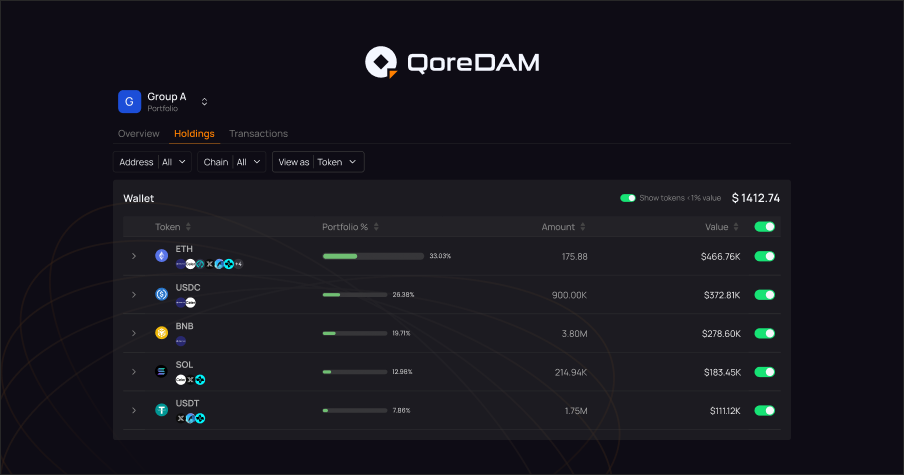
Track multiple wallets in one dashboard. Not in theory. Not via an export that you paste somewhere else. A single dashboard where every address you care about is visible together, organized in a way that maps to how your portfolio is actually structured. Fund-level views. Portfolio company views. Chain-level breakdowns. The aggregation should do the work so you do not have to.
Read-only by default. No seed phrases. No private keys. No wallet connections. You add an address, you get visibility. Nothing more. If a tracking tool cannot give you this, move on.
See activity, performance, and red flags. Good tracking is not just a balance snapshot. You need to see what is moving, when it moved, and whether the movement is expected. Unusual transfer patterns, dormant wallets that suddenly become active, large outflows before a public announcement. The tracking layer should surface these things before you go looking for them.
Simple numbers beat fancy cockpits. One of the most consistent failure modes in portfolio tooling is over-engineering the UI. Thirty-two metrics on a single screen, color-coded heat maps, three-dimensional visualizations of token correlations. Nobody needs that. What you actually need is a clean answer to a simple question: what do I own, what is it worth today, and has anything changed that I should know about? The simpler the answer, the more often you will actually look at it.
Reporting that doesn't take a weekend. The point of a crypto portfolio tracker is not just visibility. It is the ability to communicate that visibility to LPs, to co-investors, to your team, without spending two days assembling data from five different sources. Reporting should be an output of the tracking process, not a separate project on top of it.
How to Track Multiple Crypto Wallets in 10 Minutes
The mechanical process of setting up multi-wallet tracking is simpler than most people expect. The friction is usually in finding a tool that actually supports everything you need, not in the setup itself.
Here is what a 10-minute setup looks like with the right tool in place.
Start by collecting your wallet addresses. Public addresses only. You do not need anything else. Ethereum addresses, Solana addresses, addresses from any other chain you are working with. If you have a list in a spreadsheet already, copy it out.
Import those addresses into your tracking platform. A decent crypto wallet tracker will accept any public address without requiring a connection or signature. Paste it in, label it, done. Do this for every address you want to monitor, including cold wallets, treasury addresses, and any founder or portfolio company wallets you have visibility rights to.
Organize by entity or fund. Most good platforms let you create groups or tags. Map those groupings to how your portfolio is actually structured. Fund I wallets in one group. Fund II in another. Portfolio company treasuries separately. This is the step most people skip and then regret later.
Set alerts. At minimum, you want to know when a wallet you are watching shows significant outflows, when a large transaction hits, or when an address goes from dormant to active. These alerts are where a real-time crypto portfolio dashboard earns its keep.
Review the initial output. Look at the consolidated balance view. Check that token values are pulling correctly across chains. Look at recent activity and confirm it matches your records.
That is it. The ongoing work after setup is checking the dashboard rather than assembling it.
The VC Use Case
Most portfolio tracking tools were built for retail investors or individual traders. The problems they solve are slightly different from the problems a Web3 VC actually has.
A retail investor wants to know if their bags are up or down. They have one or two wallets. They care about price. The UX is built around that.
A VC managing a portfolio of fifteen or twenty investments has a different set of questions. Are the token allocations from our last round sitting where we agreed they would sit? Has the treasury of the company we backed moved anything unusual in the past two weeks? What is our aggregate exposure to the Solana ecosystem across all positions? Are any vesting contracts reaching a cliff we should be preparing for?
These are portfolio management questions. They require watching multiple wallets across multiple chains on behalf of multiple entities, over extended time horizons.
This is not a fringe use case. According to the 2025 Institutional Investor Digital Assets Survey conducted by Coinbase and EY-Parthenon, more than three-quarters of institutional investors planned to increase their digital asset allocations in 2025, with 59% committing over 5% of AUM to crypto (Coinbase & EY-Parthenon, 2025). The portfolio complexity behind those numbers is real, but the tracking tools have not kept up. Most platforms still bolt the VC use case on as an afterthought. You get a "pro" tier with more wallet slots and maybe a rudimentary labeling system. The underlying logic is still built around individual investor behavior.
What VCs actually need is a tracking layer designed for oversight rather than ownership. A system that treats wallets as objects to be observed, not necessarily as wallets you control. One that assumes you have a team, that you need to share views without sharing access, and that your reporting requirements are more formal than a screenshot of a dashboard.

Where Most Portfolio Trackers Get It Wrong
The shortcomings tend to cluster around a few recurring issues.
Chain coverage is the first one. Many crypto portfolio trackers handle Ethereum well and handle EVM chains reasonably well. Non-EVM chains are where things fall apart. Solana support is inconsistent. Cosmos ecosystem chains are hit or miss. If your portfolio has any exposure outside the EVM world, you will spend a lot of time discovering what your tracker cannot see.
Stale data is the second issue. Some platforms update balances in near real time. Others batch updates every few hours. For a day trader, this matters acutely. For a VC with a longer time horizon, it matters less moment to moment but still creates problems when you are preparing a report or trying to confirm that a transfer happened when it was supposed to.
Wallet limits are the third issue. Many platforms tier their pricing around the number of wallets you can add. If you are tracking forty or fifty addresses across a large portfolio, you will hit these limits quickly and the cost scales in ways that do not make sense relative to the value being delivered.
The fourth issue is the one most relevant to VCs specifically: the tools were not built for oversight. They were built for ownership. The read-only tracking experience is often treated as a secondary feature, poorly implemented, or simply unavailable without workarounds. A tool designed from the ground up for observation rather than control is rare.
QoreDAM: A Multi-Chain Portfolio Tracker Built Around One Job
QoreDAM was built to solve a specific problem. Not trading. Not price discovery. Not DeFi yield optimization. The problem it solves is multi-wallet visibility at scale, for people who need to monitor portfolios they do not necessarily control.
The core design principle is read-only tracking across chains. You add a public wallet address. QoreDAM monitors it. There is no connection, no seed phrase, no permission required from the wallet holder beyond sharing the address. This makes it practical for monitoring portfolio company treasuries, founder wallets, or any address you have a legitimate reason to watch, without introducing any new security exposure.
The platform supports multiple chains without requiring you to treat each chain as a separate tracking project. Ethereum, Solana, and the broader EVM ecosystem are all visible in a single consolidated view. Cross-chain totals are aggregated automatically. You are not managing eight separate tools for eight separate chains.
The dashboard is built around clarity rather than comprehensiveness. QoreDAM surfaces the information you actually need, in a format that supports quick decision-making. Balances, recent activity, notable movements. No unnecessary complexity layered on top of data that should be straightforward.
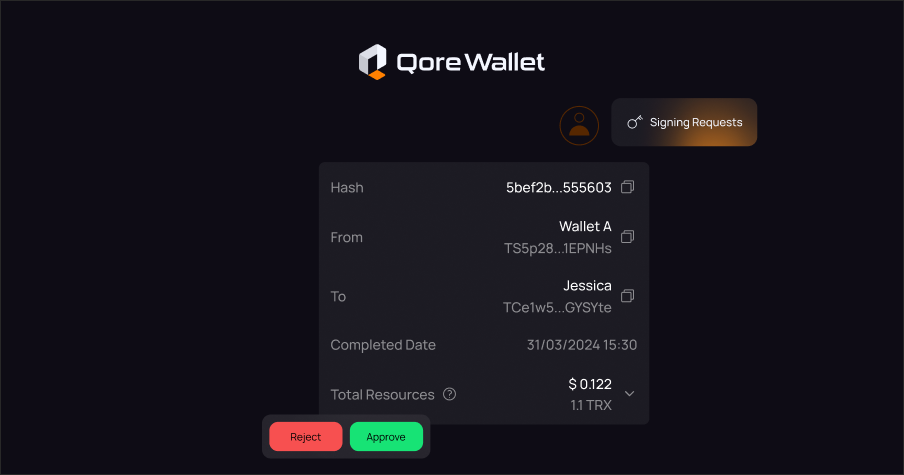
For teams, QoreDAM supports shared access without shared credentials. Multiple team members can view the same portfolio without each needing separate wallet access or separate tracking setups. This matters for fund operations where analysts and partners need the same information but should not be sharing wallet credentials to get it. For the custody and transaction side of that equation, QoreWallet handles the team controls, approval flows, and policy enforcement that sit alongside the tracking layer.
Reporting is built into the workflow rather than bolted on afterward. When LP reporting time comes, the data is already organized and accessible. You are not starting a new project to answer a question the platform should have been answering continuously.
QoreDAM is not trying to be every crypto tool in one. It tracks multiple wallets across multiple chains, gives you clean visibility into what is happening, and gets out of the way. For VCs who have spent time wrestling with sprawl, that focus is exactly what makes it useful.
Conclusion
The challenge of tracking multiple crypto wallets is not going to simplify on its own. Portfolios keep getting more complex. Chains keep multiplying. The gap between what a block explorer shows you and what you actually need to know keeps widening.
The answer is not a more complicated tool. It is the right tool, applied correctly.
Read-only wallet tracking across multiple chains, consolidated into a single view, with clean reporting built in. That is the whole job. A crypto portfolio dashboard that does that one job well is worth more than a platform that tries to do everything and does most of it poorly.
If you are still stitching together visibility from spreadsheets and block explorers, the cost is probably higher than you think. Not just in analyst hours, but in the things you are missing between the cracks. The wallet that moved unexpectedly. The vesting cliff nobody flagged. The LP report that took three days to prepare when it should have taken one.
You do not need to overhaul your entire operations stack to fix this. You need to track multiple crypto wallets in one place, without connecting anything, and without involving more humans than necessary. Start here.
References
_Coinbase & EY-Parthenon. (2025). 2025 institutional investor digital assets survey. Coinbase. https://www.coinbase.com/institutional/research-insights/research/market-intelligence/2025-institutional-investor-survey _
_Coincover. (2025, June 17). Developing resilient crypto wallets: Security best practices for developers. https://www.coincover.com/blog/crypto-wallets-security-best-practices-for-developers _